HOME | GENERAL INFORMATION | CLASS SCHEDULE | STUDENT RESOURCES | SHINKIKAN NEWS | ARTICLES | STORE
welcome to shinkikan ( e-mail us ) aikidojo houston, tx
INTERESTING ARTICLES

LEARNING TECHNIQUES

TALE OF TWO UKE

THE ROLE OF WEAPONS TRAINING IN AIKIDO

AIKIDO IN EVERYDAY LIFE

THE "KI" IN AIKIDO

ARTICLES OF INTEREST

A TALE OF TWO UKE
UKE NUMBER ONE, 1975
The munetsuki, although I saw it coming, caught me completely flatfooted. I watched foolishly as the fist collided with my midsection. I was thankful that the uke was a slender fourteen year old girl and not a 200 pound fullback, and I was highly embarrassed that I was frozen in place and unable to move. After all, I had recently received my green belt after a year of rigorous study of Shotokan Karate under the guidance of Sensei Mikami, an all-Japan champion in free-sparring and kata. I had honed over the past year a very quick front roundhouse kick, and I ordinarily moved around the ring with agility.

My temporary paralysis had much to do with context. This brief kumite took place just within the locked doors of a psychiatric unit, where I had recently taken my first job as a counselor after completing my bachelor’s degree in psychology. My uke was a highly incensed teen who had just been hospitalized against her wishes by her parents for some variety of reckless and misguided issues which I no longer recall. As I gasped in embarrassment, two of my fellow counselors, one at each of her elbows, escorted my uke to another room to cool off.

At the time, I had a limited but powerful array of defenses against munetsuki. I had repeated the sidearm blocks and rising blocks thousands of times in class, followed immediately by a menu of counter punches, strikes, and kicks. While these patterns remain even now in my muscle memory, they were not available to me on this day, perhaps for the better. These forearm blocks, which had often raised lurid hematomas on my forearms from the shock and concussion of diverting punches, could have broken the arm of teen uke.

I do not mean to claim that my inability to move or react was a failing of my karate training. I have no doubt that Sensei Mikami would have avoided that munetsuki without injurious retaliation. My loss of center and mobility had as much to do with my inexperience and immaturity as a mental health professional. My professional and personal ethics prohibited my striking out at a patient, particularly a female, yet my ability to meet aggression in a constructive and self-preserving manner was decidedly lacking.

UKE NUMBER TWO, 1993
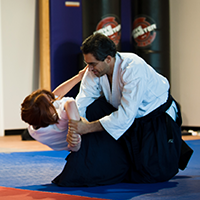
Uke moved towards me rapidly but not unexpectedly with katatetori. Although I am not certain, I believe I answered with something resembling irimi tenchinage, and uke sat back rather gently on his rear as he held on to my wrist which now projected below, to the side, and behind him. Next, uke was pinned to the floor by two assistants with techniques which would never have met promotion test requirements.

Uke number two was a stocky and powerful thirtyish man whose brain chemistry and behavior became abruptly and violently disorganized whenever he stopped his antipsychotic medication, which he did frequently. I was now the Clinical Director of the Day Hospital which provided his mental health care and one year or so into my training in Aikido. I was thankful that I had known this young man over many months and that I sincerely wished to resolve this problem without getting hurt or hurting him.

My training in Aikido allowed me to responded to conflict both physical and psychological with an effective and integrated response, unlike my encounter with uke number one. IN that instance, I froze, expressing my inability to protect myself and uke simultaneously. Maybe the two uke’s of this story are really within me instead. A divided and conflicted self perhaps can only choose paralysis or brutal aggression, with nothing in between. As we achieve some measure of harmony within ourselves, we can begin to harmonize with external uke in a constructive manner.

My next task in Aikido is to harmonize, blend with, and soothe the part of myself that really does not like to fly upside down in a breakfall as someone twists my arm. How do I welcome THAT? Isn’t life a series of interesting challenges?

- Dr. Robert Cuyler
Shinkikan
Houston TX


HOME | GENERAL INFORMATION | CLASS SCHEDULE | STUDENT RESOURCES | SHINKIKAN NEWS | ARTICLES | STORE

©2002-2003 SHINKIKAN INC. 3200 FONDREN, SECOND FLOOR HOUSTON TX 77063 TEL: 713.977.5289