|
|
2004 SHINKIKAN NEWS
KABOCHA-GIRI
Bellaire Dojo 8th Annual Pumpkin Cutting Festival

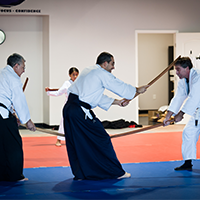
In the parking lot next to Tritico Sensei's dojo, students enjoyed a full day of kabocha-giri, pumpkin cutting. How much can you learn in one day? Well, about three different types of strikes and how to finally be able to slice through a pumpkin without your blade getting stuck in it.
Just imagine, you're on the battle field confronted by a thousand enemies, each one holding and wielding a sword at you. You are an exceptional fighter, one of the best. After your strike through 950 enemies, your blade gets stuck on your 951st strike and you are still surrounded by 9 enemies. What do you do? I’d drop the sword and take away the sword of the next person that strikes at me, then use it to defeat the rest.
Well, this is all fictional, but the point is, if the strike, cut or slice, how ever you want to call it, is not done effortlessly, the blade will get lodged inside of what you are trying to strike.
Tritico Sensei covered the following three strikes:
1.shomengiri - horizontal
2. kesa giri - diagonal
3. dogiri - side
After a whole morning of striking, and before moving on to some more advanced techniques in the afternoon, Tritico Sensei introduced everyone to the shuriken, throwing stars. These weren’t just any kind of shuriken, these were hand made by Andrew Llayl. If you are interested in checking out some quality supplies, Threz Gonzales, one of Tritico’s top students has a wonderful site at Bushidosupplies.com .
The advanced stuff , the application of the three cuts through focus, was only an introduction to the more advanced stuff for a future seminar, free application of cuts through focus and movement.
Personally, I would recommend anyone training in the martial arts to attend this seminar next year. Through Tritico Sensei’s expertise and discipline, there is a lot to be learned that will add to each one of you, as an individual, in your pursuit of excellence through the martial arts.
|
ASIAN FESTIVAL DEMO
Sunday, October 17, 2004 ShinKiKan had the privilige of demonstrating at the Asian American Festival. There were many groups and many different arts represented at the festival. I personally had the opportunity to watch a few different arts. I saw a Tae Kwon Do demonstration, followed by a Karate demonstration, then finally before I had to leave, I had the chance to watch another group perform an Aikido Demonstration.
It was wonderful to watch so many different people practicing so many different kinds of martial arts. As you know, or you should understand about the martial arts, health and safety are very important. Like Aikido, the martial arts as a whole are about being healthly and physically active. Master Vahn Bihn demonstrated that at the age of 69 he can still do push ups on his finger tips. Karate demonstrated the importance of control, by slicing through a watermellon sitting on top of someones stomache, pretty scarry if you ask me. And, before I left, I had the chance to see Walter Marker express the importance of flexability through Yoga.
All these arts are so wonderful, and even more wonderful to watch. ShinKiKan's demonstration focused on the roots of Aikido. Thomas Kurian gave a beautiful demonstration in Jujutsu, a root of Aikido. Our Aikido demo focused on using the energy of your attacker and blending in with nature.
I would like to personally thank those that attend the demonstration and especially to those that participated in it. As you know, we are trying to put together a demo team, so that the next demo will be more informative and more spectacular for the audience.
|
SHINKIKAN NEWSLETTER
We are officially starting up the ShinKiKan Newsletter. Are you interested? We need to fill the following positions:
Contributing Writers
Advertising Account Executive
Graphic Designer
The following positions have already been filled:
Publisher - Erik Sasha Calderon
Chief Editor - Amy Hirshowitz
We estimate that it will take One hour of your time per month to get the newsletter out. Amy Hirshowitz, the current Chief Editor will be taking down names and handing out positions. When you see her, let her know what you want to volunteer for.
|
NINJUTSU - BUDO TAIJUTSU
The Ninja, the real ninja, what is he? Who is he? Is he real, or is he just a myth? Who was it that created this myth? Did the ninja himself make people believe in the super natural, just to overwhelm his opponent? Master Brian Tritico, 8th degree black belt, introduced us to this mystical art of Ninpo. Interestingly, he first dispelled the myth before he and his students gave us a beautiful and powerful demonstration of his art.
"The ninja would sometimes hide with a monkey, so that when they were chased, they would release the monkey making their pursueres think that they majically turned into a monkey."
"Most of the time war's are fought and won through deception."
"Many people have used the mysticism behind the ninja to "cash-in"."
These are just a few of the points Master Tritico explained to us during the seminar. The rest of the seminar was a hands on training. No one expected such a hard and brutal class. The aim was to take out the person attacking you. To flow like water, always changing and never alowing itself to fix, but to blend into it's surroundings.
Master Tritico taught us just a few techniques, but the hour was not enough to really understand them, as Master Tritico explained, it is necessary to practice these techniques, over and over again. Learning Ninjutsu, or Budo Taijutsu, is like learning a language, one class will get you no where. The father of this art, or the head of the family is Dr. Masaaki Hatsumi, Master Tritico's instructor. There are many people who claim to be "Ninja's", but few who truley follow and practice the art.
On the 18th of September, we at ShinKiKan where given the honor and the privilage to train and learn from a direct disciple of the father of Ninjutsu.
Master Brain Tritico has a dojo in Bellaire, if you would like more information please visit his website:
www.geocities.com/bellairedojo
www.geocities.com/btritico/dojo.html
|
SUSHI PARTY
Sunday, August 8, 2004 ShinKiKan members, family and friends enjoyed three full hours of Japanese culture, food, sake and beer. We met at the restaurant Yan Sushi on Westhiemer in the Montrose area at 4:30 PM. The owner and chef began by serving us miso soup and sake. He later began passing out the ingredients we needed to produce our very own California Rolls. Yukiko, Dugan's mom explained to us that California Rolls are an American invention, so I guess we ended up making Japanese/American food.
I think the hardest part was wrapping the bambo wrappers with saran wrap. At first we tried doing it on our own, but soon realized that we really needed an on hands demonstration (it's harder than it seems.) We all got our Sushi Rice, Avocados, Cucumbers, Masago (fish eggs) and Crab. Then the chef began showing us how to put it all together. Some of us were a little adventurous and tried making our own roll after the first demonstration, but I think that proved hazardous. Alex's Mom ended up with rice stuck all over her hands (got a great photo of it.) It took the Chef three demonstrations before any of us got it right. And some of us did such a good job, you couldn't tell an armature made the roll.
OK, did I forget to mention that the sake and beer was in over abundance? Well, I think that had a lot of influence on the rolls, especially when we started trying to cut them. You'd think it'd be easy to slice an extremely sharp knife through a roll instead of your finger, but, again, almost impossible, especially after the sake and beer.
Like Aikido, making sushi is extremely simple, but then why does it take 20 years to become a chef? Like Aikido, it is the simple that becomes so complicated to master. Thank you all very much for attending, and for those that were unable to attend, keep your eyes on the calendar for our next event.
|
IAIDO
Sat., May 15, 2004. Everyone was on the mat and ready to learn Iaido. Emily Sensei and her top student, Joe Sensei were in from Clearlake Iaido to demonstrate and teach us the art of Muso Jikiden Eishin Ryu Iaido.
Iaido is the art of drawing the sword and cutting down an opponent in one movement. Muso Jikiden Eishin Ryu goes back 450 years and is traced to its founder, Hayashizaki Jinsuke Shigenobu. As with most martial arts, this style focuses on the refinement of the individual and his/her mind. Like polishing a rock over and over till it shines, a student practices the art of drawing the sword over and over until he/she is refined and "shines".
As soon as everyone was lined up and ready to go, Emily Sensei shocked us all by asking us to undress. First, she said that we all had to learn to dress properly. This style of Iaido is very particular on etiquette. Emily Sensei brought us all an Iaido Obi (belt) and taught us how to properly put it on. Those students wearing an hakama were asked to take it off. We spent over an hour going over proper etiquette and dress for Iaido. In order to be able to train properly and effectively it is very important to learn proper etiquette.
After the session on etiquette, we all began to draw our swords. Emily Sensei taught us one basic kata (form). Cutting through and adversary through the chest as you draw you sword, a second cut to finish him/her off, then one last cut to clean the blood off the sword before it is placed back in the sheath. Four movements; the first two to kill, the second two to place the sword back in its place.
Emily and Joe performed this movement over and over again to show us how to do it. Their movements were like a polished rock, clean and "shinny." So clean that it was very easy for all the students to pick up on the movements, although we all looked extremely clumsy at it.
Emily Sensei teaches three times a week in Clear lake. Please visit
Clear Lake Iaido for more information.
|
JUJUTSU
On Saturday, April 10, 2004, Thomas Kurian Sensei instructed us in the art of Japanese jujutsu. The class was systematic and extremely well explained. His years of knowledge were easily digested in simple and straight forward explanations. Even the beginning students of Aikido looked like seasoned professionals on the mat.
Kurian Sensei taught us all the art of the take down, the mount and the arm bar. He broke down the movements into three stages. First he taught us the take down, then he taught us the arm bar, and last but not least he taught us the mount. I like the way he taught the last step to the technique second and the second step last. Kurian Sensei spent the whole seminar on this one technique, which is very like the Japanese culture. To know one thing very, very well is 10,000 times better than know several different things not so well. Like the American saying, "Jack of all trades Master of none."
|
Japan Festival
Last Saturday, April 3rd, a group of ten of our students represented
Shinkikan Dojo at the 11th Anniversary Japan Festival, held at Hermann
Park Japanese Garden. Don Ramirez kicked off the show by introducing our
newly added Jujitsu Group. Sensei Thomas, who with his two uke gave a
short but very effective demo of the various locks and grabs used in
this Japanese fighting art. It was then the turn of the Aikidoka to
present their techniques. The demo was given in the form of a class, led
by Kevin Mackay demonstrating a move with the help of Scott Reese taking
ukemi. The students then practiced back and forth with their partners.
Don emceed and explained to the audience the need to start off slowly,
introducing new students to easier movements, progressing onto the more
difficult and faster throws and falls. Demonstrations of Kokyo-ho,
Shihonage, Kote-gaesh and Ikkyo gave the audience a good idea of the
variety of techniques used in Aikido. We ended the show with a brief
flurry of Juiwaza given by both Scott then Don, with Kevin taking ukemi
for each. Although initially perhaps there was apprehension on everyone's
part at having to take ukemi on a hard thinly carpeted wooden stage
instead of on the grass, everyone did extremely well and hopefully we
haven't got too many bruises from our experience. A good time was had by
all and we can be proud of the show our fellow students put up on behalf
of Shinkikan.
Students taking part included Peter Marosi, Alexandra Rowan, John
Collingwood, John Shukers, Damien Falcon, Andras Feszthammer, Srinivassan
Pillaipakkam, Vladimir Collak, Scott Reese, Kevin Mackay, Don Ramirez.
|
SHODO
On March 20, Saturday, ShinKiKan hosted a seminar in Shodo. Mrs. Yasuoka, 8th degree black belt, gave the seminar. The students thought that it would be easy and fun. They soon learned that Shodo requires discipline and patience. Making the ink took 20 minutes of grueling concentration. Rubbing the ink stick into the ink stone over and over and over, until the water turned a thick black. She told us that masters sometimes spend 2 hours making their ink. Making the ink, was not as difficult as trying to draw the Japanese characters. Mrs. Yasuoka had us draw the character for "michi" or "way"; "DO". It is the same do as in Aiki-do-. This "do" comes from Taoism. It was amazing how she was able to link Aikido with Shodo. The writing of the character was extremely complex. Holding the brush, drawing each line and the order in which each line is drawn is what made it so difficult. Just like an Aikido class, it's challenge and difficulty is what makes it so fulfilling. Everyone left with some artwork to frame and a smile on their face.
|
Shotokan Karate
Yesterday, Satruday, Febraury 21, 2004, ShinKiKan had it's first Shotokan Karate seminar. It was a true success. Juan Guerrero, 3rd degree black belt, instructed us all in the art of Shotokan Karate. He has been studing and training in Shotokan for over 30 years. He spent a lot of time explaining to everyone about the art and arts in general. He talked about the similarities and the differences between Aikido and Shotokan. After that introduction, he got everyone up and began the lesson. A lesson that lasted more than one hour. Teaching everyone the basics of punching, kicking and blocking.
After a while it looked like everyone was catching on. It looked like everyone had been doing Shotokan for years. Juan showed everyone a kata and everyone was doing it like they had been doing it for years. I was thoroughly impressed with everyones ability to pick up a new art that fast. After going through the kata, the students paired up and practiced their blocking and punching skills.
For those of you that were at the seminar, please consider what you learned. Think about it. How is Aikido similar to Shotokan Karate? How can this lesson help you improve and advance as a human being?
Next month we will be having a calligraphy seminar, known as shodo. Please check back for the specific date and time.
|
Tea Ceremony
Showing Japan, a non-for-profit group that dedicates it time and energy to show the art and culture of Japan, gave us a wonderful demonstration as well as an explanation on The Art of Tea. Harmony and respect, two very vital ingrediants for Aikido, were demonstrated in detail through this ceremony. It was amazing to see the precision in each movement that was made by these highly skilled chado practioners. Every movement made has a meaning, and every movement made is very profound. Just watching the ceremony might bore you, but being served is a completely different world. Especially having to sit in seiza for 20 minutes.
Everyone that was present got a chance to make tea, and everyone got to try it. It's green tea, but the powdered kind, not the leaves. This means that it has a much stronger flavor and is always served with a Japanese sweet. The tea, the sweet, the cup, the sitting position, the way the tea is prepared, we even had to sit on traditional style tatami (straw mats)...it was just all so incredible...how profound a simple ceremony can be...
|
OCT2003 SPECIAL BEACH TRAINING SEMINAR
The weather was more than perfect. Deep blue skies, a cool breeze and the thunder from the waves. This years special training with Kato Shihan was more than spectacular. We spent some time cleaning up the beach from the shells, then we went into training. For two straight hours we did weapons, both the sword and the jo. We started off with the jo, Ikkyo through gokyo. It was tough getting used to the sand and the shells on the beach, but it helped us understand the importance of being aware of you enviornment. Always training in the dojo can be a handicapp. We get too used to a controlled enviornment. We need to get out and train in the open air, on the sand, on the grass, on the concrete, in the water; whereever we get a chance to train Aikido, we should take advantage of that. Kato Sensei said in his interview that we should be greedy about our training. It is for us to train and to learn about ourselves and about Aikido.
After the Jo we moved on to the Sword and did KiriKaeshi. The intense training and the facination with the sword drew a large crowd of spectators. They watched as we moved out of the way from oncoming swords, you'd have thought we were making a movie.
Next thing we knew it was quiting time. Two hours flew by like 10 minutes. We put up our weapons and started our bar-b-que. Beer, Beef and Chips for three hours. I'm glad I wasn't the one driving back.
|
CHILDRENS TESTING
ShinKiKan had its first official kids promotions. Miki Calderon, Mike Nguyen, Ryu Calderon, George and Costa Pollos and Taka Calderon all participated in ShinKiKan's first official promotions. The children displayed a wonderful attitude and an incredible level of discipline. It was amazing to see six, seven, eight and ten years old sit in seiza the entire testing without even a whisper. Parents would be amazed to see their children sitting in a formal posture without moving for over twenty minutes.
The childrens class meet twice a week on Wednesdays at 4:20 PM and on Saturdays at 11:10 am. Watching these children learn and train in Aikido is a pure joy.
If you are interested in watching a class, please stop by during the childrens lesson times or if you have any questions, please email the dojo at dojo@shinkikan.com.
|
NEW SHINKIKAN WEBSITE UNVIELED
We are proud to present the new face of Shinkikan.com: A website dedicated to all things Aikido. Along with a new look we've included, interesting Aikido-related articles and valuable student resources to help Aikidoka of all levels.
|
JAPAN FESTIVAL DEMONSTRATION
Shinkikan's first demonstration at Houston's 10th Annual Japan Festival was a great success. Hundreds of visitors gathered near the Japanese Gardens in Herman Park on April 5th and 6th, 2003 to enjoy a variety Japanese cultural exhibits.
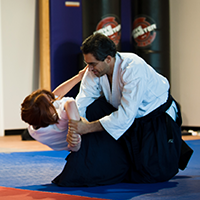
Erik throwing Weldon
|
|
SHINKIKAN DISCUSSION GROUP
ShinKiKan Aikido Discussion
May 1, 2003, 7:30 PM
Discussion Leader: Bob Cuyler
This will be our first meeting of a regular discussion group on aikido. My plan is to distribute some notes or thoughts as a discussion starter. I am very open to new topics, articles to discuss, etc. Please contact me at bob.culyer@shinkikan.com or 281-705-2775 for your input.
Session 1: The paradox of aikido
One of the most intriguing aspects of aikido is the tension between the martial and spiritual roots of aikido. How is it that a martial art (which involves a wide variety of self-defense applications, which we all know are effective, sometimes painful, and potentially very injurious) is at its heart ‘the art of peace?’ The history of aikido reflects a fundamental shift from a combat system (jutsu) to a martial way (do) as O’Sensei underwent a personal transformation. I thought the following two quotes would give a feel for the nature of the transformation.
The first is a recollection of Sokaku Takeda, who was probably the most influential martial influence on O’Sensei and almost certainly the source of much of the technical form of aikido:
From “Aikido Masters :Prewar Students of Morihei Ueshiba”
“Takeda Sensei was a martial artist in the old sense. When he saw a person he saw an enemy. If I were to try to give an example I would say that if a person happened to come to visit him he would “greet” him by instantly grabbing the steel chopsticks from the brazier and shouting, “Who’s there?” Then he would storm out to the entrance way. He was like someone from the Warring States period (1482-1558) who saw his seven proverbial enemies in every group of people. He was a man of deep distrust, whose personality never revealed the slightest opening. If you happened to ask even a small question he would bellow, “Dare you doubt my technique!” That’s how violent his temperament was!
The second is from Memoir of the Master, Morihei Ueshiba
As ai (harmony) is common with ai (love), I decided to name my unique budo “Aikido,” although the word “aiki” is an old one. The word which was used by the warriors of the past is fundamentally different from that of mine. Aiki is not technique to fight with or defeat the enemy. It is the way to reconcile the world and make human beings one family. The secret of Aikido is to harmonize ourselves with the movement of the universe and bring ourselves into accord with the universe itself. He who has gained the secret of Aikido has the universe in himself and can say, “I am the universe.”
Therefore to compete in techniques, winning and losing is not true budo. True budo knows no defeat. “Never defeated means never fighting.”
|
SHINKIKAN PRODUCTIONS
ShinKiKan will be producing its first Television Production. We will have our first meeting on Thursday, April 24, 2003 at 7:30 PM at the Dojo. All ShinKiKan members are welcome to participate in making our first TV Show a big success.
|
|
|